In today’s rapidly evolving business landscape, traditional audit cycles are no longer enough to keep organizations protected, compliant, and operationally resilient. The pace of change has accelerated dramatically — risks are becoming more dynamic, data environments are growing more complex, and regulatory expectations continue to rise year after year. Because of this, businesses can no longer rely solely on periodic assessments that offer only a snapshot of their compliance posture at a single moment in time.
As a result, companies are shifting from static point-in-time audits to a far more proactive, intelligent, and technology-driven approach known as continuous assurance. This model integrates real-time monitoring, automated control checks, and data-driven insights directly into day-to-day operations, giving organizations immediate visibility into potential issues.
What Are Internal Audits?
Internal audits are conducted by an organization’s own audit team or by a hired internal audit firm. Their primary purpose is to evaluate internal controls, risk management processes, and operational efficiency.
Key Characteristics of Internal Audits
- Independent but part of the organization
- Continuous or periodic based on business needs
- Focus on strengthening processes and identifying risks
- Help management make informed decisions
- Assess operational, financial, compliance, and IT controls
Why Internal Audits Matter
- Internal audits allow businesses to:
- Detect issues early before they escalate
- Improve internal processes and governance
- Maintain year-round compliance
- Enhance accountability across departments
- Build a strong foundation for external audits
- Internal audits act as a proactive layer of protection, ensuring controls operate effectively on a daily basis.
What Are External Audits?
External audits are conducted by independent, third-party auditors. Their main objective is to validate the accuracy of financial statements, assess compliance, and provide an unbiased perspective on the organization’s controls and reporting.
Key Characteristics of External Audits
- Completely independent of the organization
- Usually annual, mandated, or regulatory in nature
- Focus on financial accuracy, compliance, and transparency
- Provide assurance to shareholders, regulators, and the public
Why External Audits Matter
External audits help organizations:
- Strengthen credibility with investors and stakeholders
- Ensure compliance with laws and industry standards
- Identify risks overlooked internally
- Validate the accuracy of financial reporting
- Build trust through independent verification
External audits provide the impartial assurance required for sound governance and regulatory alignment.
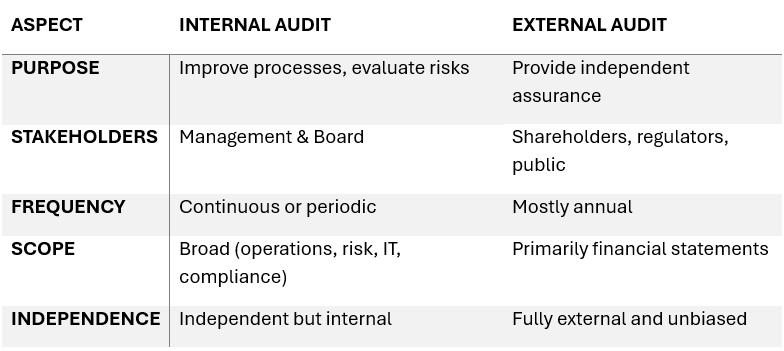
Internal vs External Audits: Key Differences at a Glance
Why Organizations Need Both
While internal and external audits serve different functions, they work together to create a complete audit ecosystem.
Strengthened Governance
Internal audits improve daily processes; external audits validate them independently — giving management and stakeholders complete confidence.
Better Risk Management
Internal auditors identify issues early, and external auditors provide an impartial second layer of oversight.
Higher Compliance Standards
Internal audits maintain continuous compliance, while external audits ensure regulatory alignment and certification readiness.
Improved Operational Efficiency
Internal audits help optimize processes, and external audits highlight gaps and industry best practices.
Greater Organizational Transparency
Together, they build trust among customers, partners, investors, and regulators.
Conclusion
Internal and external audits are not competing functions — they are complementary pillars of a robust compliance and governance framework. Internal audits deliver continuous oversight, process improvement, and early risk detection, while external audits provide independent assurance and regulatory credibility.
When combined, they create a powerful ecosystem of trust, accountability, and resilience that supports sustainable growth.
Eager to see how these changes will elevate performance standards and user satisfaction!