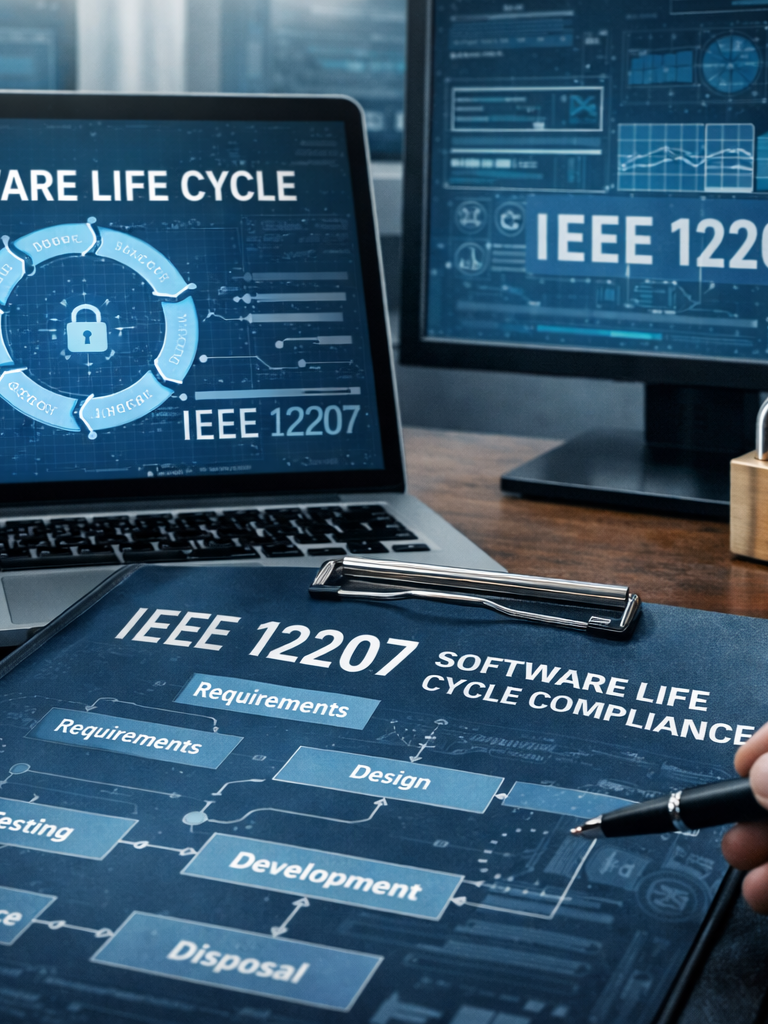
In an era where software powers business operations, safety systems, digital platforms, and mission-critical applications, organizations need a clear and dependable framework to ensure consistency, quality, and compliance throughout the software development life cycle. With teams working across complex environments and evolving technologies, having a unified standard becomes essential. IEEE 12207, one of the world’s most widely adopted international software life cycle standards, provides exactly that foundation.
Designed to standardize the processes used to develop, operate, maintain, and eventually retire software, IEEE 12207 brings structure, discipline, and clarity to software engineering practices. By defining process groups, documentation expectations, and lifecycle activities, it helps teams deliver safer, more reliable, and more maintainable products while supporting stronger audit readiness and long-term organizational assurance.
What Is IEEE 12207?
IEEE 12207, formally known as “Systems and Software Engineering — Software Life Cycle Processes,” is an international standard that defines the complete set of processes involved in the software development life cycle (SDLC).
It provides a unified framework that organizations can use to plan, control, and improve their software processes, regardless of methodology — whether traditional, agile, DevOps, or hybrid.
Why IEEE 12207 Matters
Standardized Life Cycle Processes
The standard ensures that every software project follows a structured approach, reducing inconsistencies and improving quality across development, maintenance, and operations.
Risk Reduction and Predictability
Clearly defined processes help organizations identify risks early, enforce discipline, and ensure predictable project outcomes.
Compliance and Audit Readiness
IEEE 12207 is widely used in regulated industries — including aerospace, defense, medical systems, and critical infrastructure — making it an essential reference for audits, certifications, and quality assessments.
Better Communication Across Teams
The framework provides common terminology and process definitions, allowing engineers, managers, and auditors to collaborate more effectively.
The Core Process Groups of IEEE 12207
The standard breaks down the SDLC into three major process categories:
Primary Life Cycle Processes
These are the core software activities:
- Acquisition
- Supply
- Development
- Operation
- Maintenance
They guide teams through the full journey from procurement to sustainment.
Supporting Life Cycle Processes
These processes ensure quality and control throughout software development:
- Documentation
- Configuration management
- Quality assurance
- Verification and validation
- Joint reviews and audits
- Problem resolution
They serve as the checks and balances of a software project.
Organizational Life Cycle Processes
These define how organizations manage and support their software capabilities:
- Management
- Infrastructure
- Training
- Improvement
They ensure long-term maturity and scalability.
How IEEE 12207 Supports Compliance
Compliance with IEEE 12207 gives organizations:
- Clear traceability from requirements to testing
- Evidence for process audits and regulatory assessments
- Improved documentation quality
- Stronger change management and configuration control
- A lifecycle model aligned with industry best practices
For audit companies, the standard provides a reliable framework to evaluate process maturity and identify gaps in software governance.
IEEE 12207 in Modern Development Environments
Although the standard was originally aligned with traditional development models, it has evolved to support modern engineering methods:
- Agile teams use it to ensure discipline and documentation without slowing creativity
- DevOps pipelines map their continuous integration and deployment processes to standard verification and validation steps
- Cloud-native projects use it to manage modular, distributed components responsibly
Its flexibility makes it relevant across industries, business sizes, and technology stacks.
Conclusion
IEEE 12207 simplifies software life cycle compliance by providing a clear, structured, and universally accepted framework. For organizations that need reliability, auditability, and long-term scalability in their software development processes, it serves as a powerful guide.
By adopting IEEE 12207, companies not only improve engineering quality but also strengthen their compliance posture — creating software that is safer, more consistent, and ready for regulatory scrutiny.
I look forward to seeing how these developments will improve service levels and customer satisfaction in the freight industry!